
My journey with a giant: Desmond D’Sa
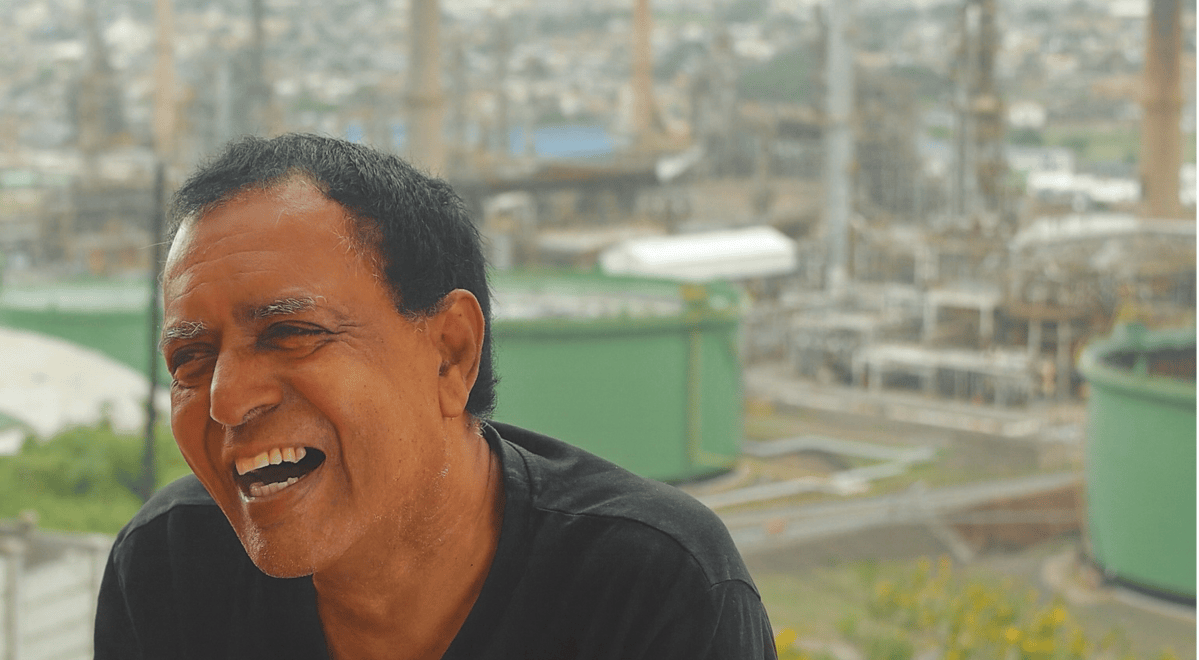
by Rory O’Connor, a founding member of SDCEA
Desmond Matthew D’Sa. I have always thought there was something grand in that name. For the Irish, the name Desmond carries connotations of regional pride and resistance, particularly during the 16th-century Desmond Rebellions against English rule. With time the name became interpreted in a broader Celtic sense as being a “man of the world” or a “gracious defender” as derived from its separate Anglo-Saxon usage. Some will say that a name can carry cultural, historical, or familial expectations or that a name can express a calling, destiny, or character trait. Others will say a name maketh not the person, rather the person makes his or her own name – in the sense of reputation, where meaning and weight is developed through how they lived, worked and treated others.The Desmond that I knew from our journey with the South Durban Community Environmental Alliance (SDCEA) from 1995 to present day, was all these things. A fearless, courageous, yet gracious defender, and a charismatic leader. A warm hearted man, always available to hear the voices of those who needed their voice and story to be heard, and always kind and considerate to those he knew and worked alongside. Within the newly formed, culturally and racially diverse, early SDCEA, Des proved to be able to mend bridges and adeptly navigate the oft stormy cultural and post-apartheid suspicions and divisions with ease. SDCEA then was filled with hot-headed activists, inflamed with righteous passion, empowered with brand new Constitutional rights, whose energies required focus and direction, much as one would do with sunbeams and a magnifying glass. Des in short time proved himself to be a masterful facilitator, networker and valued organiser within our young Alliance and was a natural fit for our need for an office coordinator when the time arose.
To those he confronted, however, he was fierce, tenacious, indomitable. A firebrand when accountability was required and a man who would never, ever be cowed. When he spoke, there would be silence as he skilfully disassembled even the most carefully and expensively crafted industry response (consultant-based, of course) to some environmental insult, and then explained it in a way that would be easily understood and resonate with those being assaulted. He was always brutally honest about his views. Government, polluting industrialists and scheming paid-for consultancies would be informed of their failures and put on notice that they needed to mend their ways. So yes, in this town Des unfortunately made many enemies along the bumpy environmentalist road that we travelled together. His home was firebombed, he received threatening anonymous calls, he was interdicted and faced prosecution in terms of the National Key Point Act (the legislation that shields the dirtiest of polluters from public scrutiny), but none of this deterred Des. If anything, it made him fight with even more passion. His daily work would see him administratively overseeing SDCEA and simultaneously being in the trenches with the local South Durban communities forced to live cheek by jowl with toxic and flammable fenceline neighbours – an as-yet-unremedied legacy of apartheid-era Group Areas Act spatial planning. “Pollution,” Des would often remark, “knows no boundaries.” And neither did Des. When not embroiled in confronting the two local oil refineries, or taking on Mondi’s fly ash, or supporting the Bluff communities assailed by emissions from the Island View Cutler Complex, or assisting the KZN Fisherfolk, he would be found leading the activist charge against Wasteman’s Bul Bul Drive toxic landfill (that saw Denny Larson’s Bucket Brigade US EPA certified sampling science deployed). Des was environmentally colourblind and embodied the concept of Ubuntu in the sense of “I am because we are”, so he wouldn’t hesitate to assist traditionally white communities of the Bluff or those impacted with Enviroserv’s Shongweni landfill or Cornubia’s UPL chemical fire.
Further afield, Des became embedded with the communities of Sasolburg, empowering local activists to find their voice and place at the table.In Zululand, he was on the ground, delivering logistical, human rights resources and media visibility to the iMfolozi communities through MCEJO, facing off against the Somkhele coal mine mining right alongside a protected area national treasure. In the Transkei, he was with the Mtentu community to form the Amadiba Crisis Committee as they faced multiple attacks to their way of life, ranging from titanium strip mining, imposition of SANRAL’s Wild Coast Toll road and Shell/Impact Africa’s seismic offshore blasting. He stood with the Kennedy Road shack dwellers, that was to become Abahlali baseMjondolo (AbM), demonstrating cross-neighborhood solidarity and operational legitimacy to what would become the largest organisation of the militant poor in post-apartheid South Africa. All these community action groups would have their leaders assassinated, illustrating again that those championing environmental justice could have tragic and fatal consequences. But this would never deter Des from using his unique ability to harness the individual voices into a collective and then to organise them into broader formidable grassroots fronts.
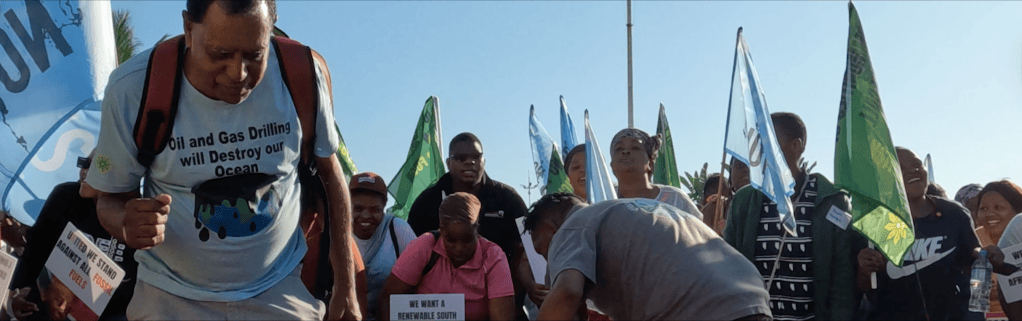
Although taking a campaign to the street was a highly effective and visible strategy, the battle was more often waged with the pen, which Desmond readily acknowledged could be mightier than the sword. So he would be found late into the night poring over documentation, assisting with critiquing and writing rebuttals to EIA’s, commenting on Government legislation and regulation, and inputting to White and Green Papers. For years we were sucked into the APELL and AGENDA 21 process and the multi-year SEA for South Durban, all whilst simultaneously serving on SO2 monitoring committees, Disaster Management, and many other refinery and environmental forums. SDCEA had an alliance with the Legal Resource Centre, and later with Centre for Environmental Rights and others, that required countless hours of organising community responses; then collating that community knowledge together with scientific data for purposes of legal interventions. If all this wasn’t enough, Des would also be running his local Durban Toxic Tours, starting a Richards Bay office, engaging in numerous oil and gas, air and health campaigns, while sourcing international funding, reporting back to funders and lending physical on-site, in-person support to international environmental struggles. He was acknowledged internationally, receiving the prestigious Goldman Prize (a Green Nobel prize, if you like), but unacknowledged locally until 3rd July this year, when he excitedly messaged me to say that, out of the blue, he was being nominated for the KZN Premier Award for Excellence, and that he and his wife, Beatrice, were to attend the ICC that very same evening. Des went on to win the award, but, as he said to me later that evening, what meant far more to him was for the “first time being introduced to Government.” Finally, he was no longer their adversary, but rather a “fearless champion”, who “dedicated his life to advocating for vulnerable communities” (as the Parliamentary Committee on Foresty, Fisheries and Environment statement described him this last week). Notable, too, was that the Deputy Minister himself attended his funeral. Des would have been tickled pink with all the acknowledgments he has been receiving.
In closing, Des was one of the few who not only talked the talk, but also walked the walk. Those who follow in his footsteps on the path to environmental justice will find his boots very difficult to fill, but he has lit the way.
To my friend and mentor, sleep well.
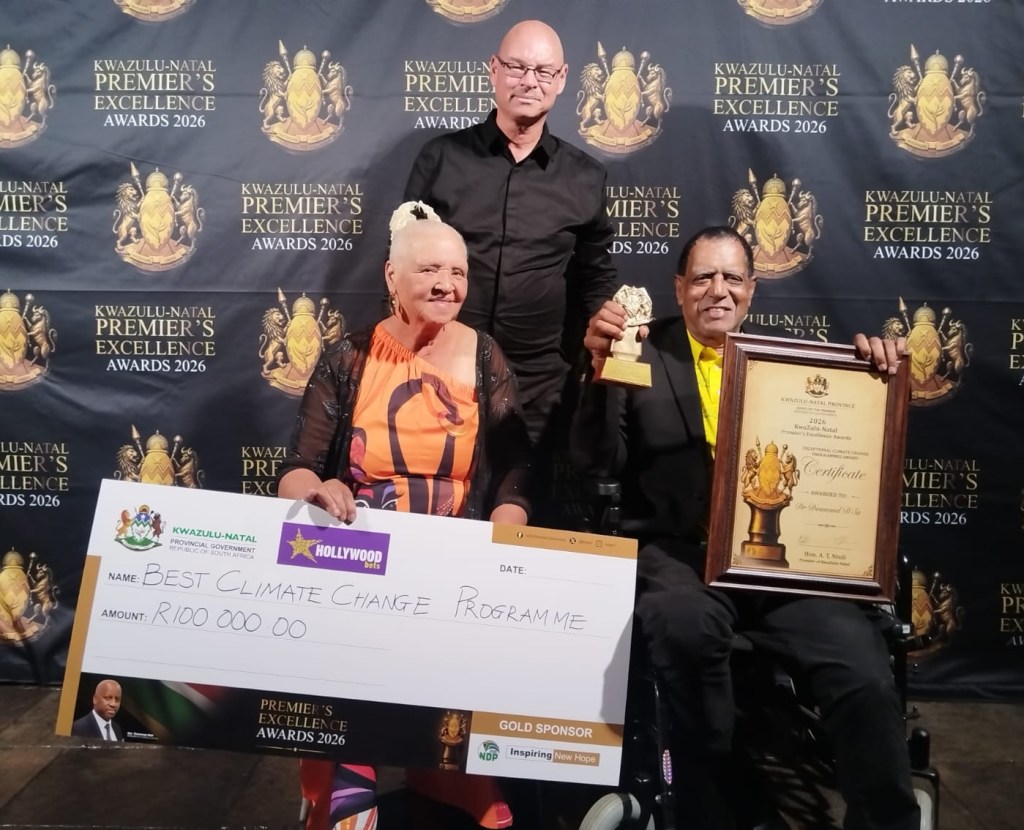
Dr Desmond D’Sa seated right, with his wife Beatrice and son Rodney
References
Top 2 photos – stills from the documentary Blue Burning 2024, in which Desmond features and showing his significant role in the rise of the Oceans Not Oil movement.


