
Environmental Minister Creecy Dismisses Appeals against drilling 10 Offshore Oil Wells
Minister of Forestry, Fisheries and the Environment(DFFE) , Barbara Creecy, has dismissed 8 significant appeals against the proposed TotalEnergies EP South Africa BV exploration drilling of 10 wells in an area of interest 9711km2 roughly between Port Nolloth and Hondeklip Bay on the West Coast.
She believes that oil and gas major TotalEnergies, “supports the objectives of the Paris Agreement on Climate Change and shares its ambition of reducing greenhouse gas emissions in the context of a sustainable development and the fight against poverty. Since 2020, the applicant has stated its ambition to get net zero by 2050, together with society and has set ambitious and rigorous objectives to transform within the decade 2020-30.” Also that TotalEnergies,”plans to decarbonize the energy products offered to end customers, reduce its direct and indirect emissions on its operations, strengthen its climate objectives, and further accelerate investment in its transformation.” Creecy says,” that it is the industry’s responsibility to reduce methane emissions near to zero by 2030.”
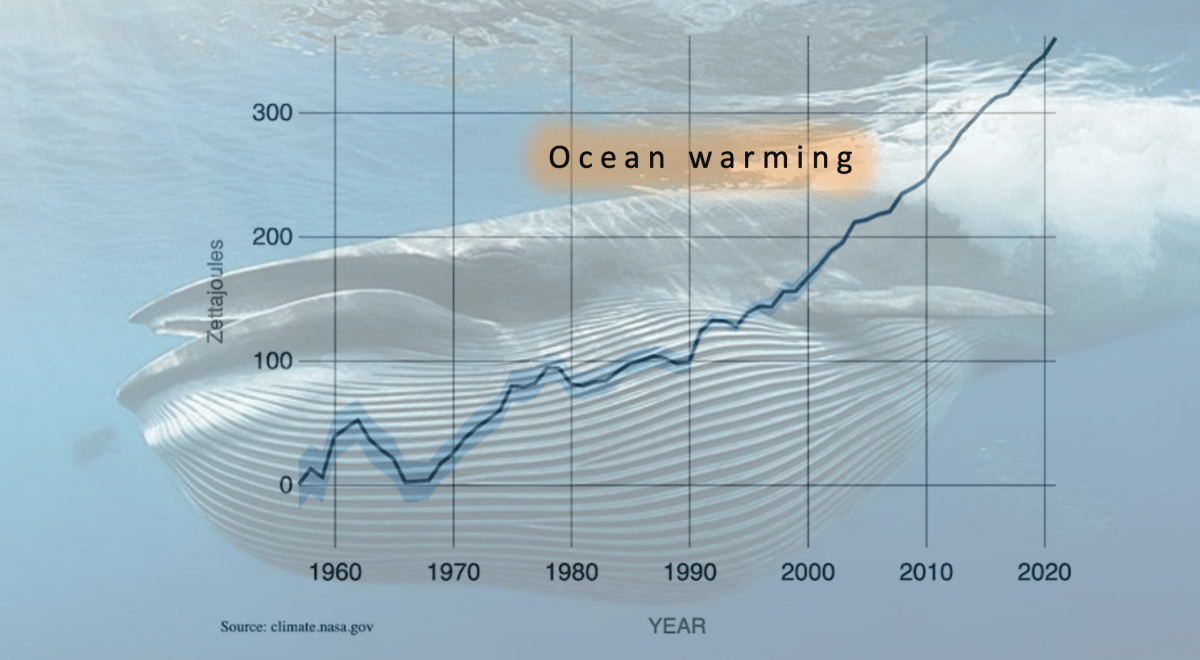
Meanwhile 90% of global warming is occurring in the ocean (NASA). The global average sea level rise from 2022 to 2023 was nearly four times the increase of the previous year. As we write the most extensive coral bleaching event on record is happening to more than half the planet’s coral (54% and counting 1% every week).
Local coral reefs in iSimangaliso have a bleaching threshold of an ocean temperature of 28.5 °C likely to be discernible as early as 2028 [1], except recent research shows high levels of run-off organochlorine pesticides in their soft corals could reduce their resilience to global warming[2]. Rapidly melting land ice is introducing fresher seawater into the life giving ocean circulatory system, meaning that less seawater sinks to the bottom, slowing the system and threatening its collapse, unless we hold global warming to 1.5C.
In response to Oceans Not Oil’s statement,
“that there is a deeply flawed timeframe underpinning the DWOB project’s concept of energy transition to carbon neutrality. Exploration wells take up to ten years or more to complete; extraction can take anything from twenty to fifty years for completion (MacFayden & Watkins 2016), which, situated on the project description timeframes, would take activities well past 2050. To assume to be drilling wells in ten years from start-up makes the fundamental assumption that planetary tipping points and accelerating climatic events will wait, and that their consequential greenhouse gas (GHG) emissions will be benign. The assumption that current climate conditions will remain stable is, at best, unrealistic and, at worst, catastrophic”
Creecy kicks the can down the road, “In terms of section 81(4) of the MPRDA, the Minister of Mineral Resources and Energy may only renew an exploration right for a maximum of three periods not exceeding two years each. The applicant is already half-way through its first renewal period. As a result, assuming the applicant requires all 3 renewal periods to complete the proposed 10 exploration wells, this work would need to be completed during 2028. If the exploration indicates that there are viable reserves, the applicant will need to conduct an ElA and obtain an EA and production right before production can arise. This will require an assessment of inter alia the legal framework and policy governing climate change and GHG emissions that exist at that time. The legal framework at the time will inform whether production is permissible and, if so, if the applicant must comply with specific conditions or requirements….
The project will not result in carbon lock-in inequalities. The project authorises exploration with insignificant contributions to GHG emissions. No oil or gas will be produced. As a result, the question of carbon lock-in is not relevant. Similarly, as the GHG emissions arising from the project are insignificant, they will have no bearing on global carbon budgets. “
[1] Schleyer, M. H., Floros, C., Laing, S. C., Macdonald, A. H., Montoya-Maya, P. H., Morris, T., … & Seré, M. G. (2018). What can South African reefs tell us about the future of high-latitude coral systems?. Marine pollution bulletin, 136, 491-507.
[2] Tyohemba, R. L., Humphries, M. S., Schleyer, M. H., & Porter, S. N. (2022). Accumulation of commonly used agricultural herbicides in coral reef organisms from iSimangaliso Wetland Park, South Africa. Environmental Pollution, 294, 118665.

 Oceans Not Oil