
Oversight

Sustaining the Wild Coast/Shell ConCourt – long read
By the time we had packed up our camera equipment, and filmed the Flame of Democracy kept burning outside the Constitutional Court by its invisible gas supply, the reviews of the Sustaining the Wild Coast NPC and Others v Minister of Mineral Resources and Energy and Others; Natural Justice and Another v Minister of Mineral Resources and Energy and Others case were already online. So today I write with another part of my activism, another form of interventionism, a form of agency that is, and also formulates, resistance and objection, knowledge and solidarity. I write with my filmmaker hat on, which sees human presentation as a political act, and asks whose voice is being amplified and whose narratives fall silent. Behind every affidavit are real people and more-than-human realities.
This case, which pitched Wild Coast communities against Shell, Impact Africa, and the Minister of Mineral Resources and Energy, turned on questions of legality, remedies, and procedure. But beneath the legal arguments ran a deeper theme–one that haunted the Oceans Not Oil campaign, and likely every other resistance to oil and gas: invisibility. Who and what was rendered invisible by the processes of consultation, by the reasoning of the Supreme Court of Appeal (SCA), and by the remedial tools of the law? And conversely, what forms of reliance or investment were made visible, counted, and weighed?

LANDLOCKED
The ConCourt is landlocked, so the only hints of the ocean were in the beaded glints in the horizontal blue of the national flag artwork and the sun-bleached kerchief about the neck and shoulders of Port St John’s fisher Sonwabo Khangela seated, absorbed, in the public gallery, and the sea of Masifundisi, Coastal Links, Right to say No and CJCM protester legs seen through the street level, horizontal, picture window in the court. No sea life swam through this court as it might in a documentary like Blue Burning (2024), where the High Court scene opens to the heartbeat of a whale shark. Film can show what the litigation record cannot always: the way culture is embedded in breath with salt air; the lived anxiety of climate change; how oil and water are immiscible, how environmental harm is harm to dignified living. Film can show who and what is lost at times behind legal abstraction, demystifying legal reasoning to invite understanding not just of outcomes but how decisions are reached. Of course, all this depends on how a film is constructed, much like a legal argument–neither is neutral, both shaping what is visible.
ROLLING REGISTER
As we prepared cameras for the arrival of the bench of nine justices, I glanced across at my long-time collaborator, Viki van den Barselaar-Smith, to check in with her. Viki edited the documentary Becoming Visible (2018) with me, which raised the question of the offshored seismic survey harm to marine life wellbeing and to fisheries based livelihoods. The film also linked South Africa’s offshore oil and gas Phakisa agenda to repeals in mitigatory regulation and warned of future climate harms by lubricating the entry of oil majors onto our coastline. As a direct result of networks formed during the Becoming Visible production process, the Oceans Not Oil (ONO) coalition, comprising 11 NGOs then, was established with the explicit socio-ecological mandate to halt offshore oil and gas development along South Africa’s coastline.
Viki also collaborated on Blue Burning (2024), which followed the ONO story through grassroots testimony–from the first resistance case in June 2021, when South Durban Community Environmental Alliance (SDCEA), with NGO’s Natural Justice and Green Connection, challenged the Environmental Authorisation granted to Eni South Africa and Sasol for exploration in Block 236 off the KwaZulu‑Natal coast on multiple grounds that pre-empt this week’s case[1]–to the Supreme Court ruling on this Wild Coast v Shell/Impact Africa case. Viki filmed with me through the To-Hell-with-Shell protests ONO organised with volunteers and partners the length of our coastline, and in the Niger Delta when we were invited by the impacted Ogoni fishing community to document the devastated waterways and livelihoods left in the wake of Shell’s operations there. I wondered who else in the ConCourt understood her contribution apart from some of the appellants? Many of those present at the hearing have worked tirelessly, behind the scenes, within their respective fields, to bring the case for justice and precaution in offshore oil and gas development before the highest court in the land.
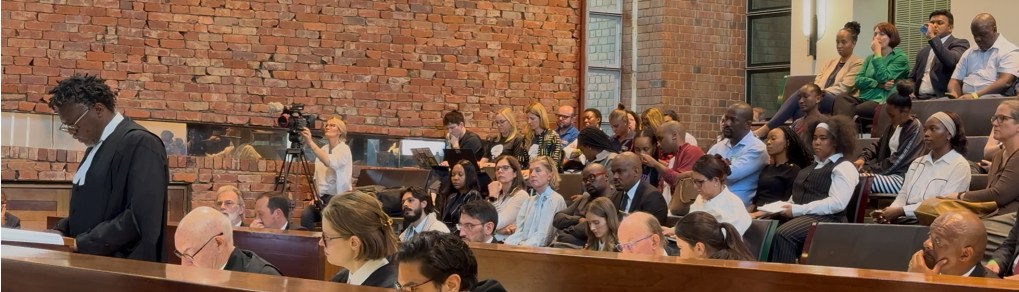
Listening to Senior Counsel Thembeka Ngcukaitobi’s arguement: Sinegugu Zukulu and Margie Pretorius from Sustaining the Wild Coast, Attorneys Ricky Stone and Cormac Cullinan of Cullinan and Associates, Nonhle Mbuthuma of Amadiba Crisis Committee, Wilmien Wicomb and Kimal Daniel Harvey from the Legal Resources Centre, Nomfundo Ntshangase from South Durban Community Environmental Alliance, Melissa Groenink-Groves, Delme Cupido, Thamsanqa Malusi from Richard Spoor Inc, Katherine Robinson, Celokuhle Zondi, Rantsho Moraka, Zenani Mhlungu, Amelia Heyns, Lucien Limacher, Jacqueline Rukanda and Farida Aliwa from Natural Justice, Sherelee Odayar from Greenpeace Africa, Kirsten Youens and Janice Tooley from all Rise Attorneys for Climate and Environmental Justice, Siphesihle Mvundla from groundWork, Tumeleng Mphake from Centre for Environmental Rights, Carmen Mannarino from Masifundisi amongst others.
We were in the Constitutional Court because the Supreme Court of Appeal (SCA), which confirmed that Shell’s exploration right and its renewals were unlawful, had controversially suspended an order of invalidity to an application for a third renewal by Shell, provided the lapses in consultation, as required by section 79 of the MPRDA, and other procedural defects could be “cured” through a fresh participation process. This suspension, the communities argue, nullifies their victory.
SUSPENSION NOT PLEADED
But, as Senior Counsel Thembeka Ngcukaitobi made clear in his opening statement, only at the SCA did it emerge that Shell had applied for this 3rd extension, obviously nervous that the second would expire during proceedings. The SCA relied on this third extension to say Shell and Impact Africa could keep the exploration right, even though it had already been declared invalid by a lower court. Ngcukaitobi told the Court the suspension was imposed without notice or submissions, violating the audi principle[2] and communities’ constitutional right of access to justice.
ABSENCE OF AUDI
But here’s the catch: neither the Minister of Mineral Resources, nor Shell, nor Impact Africa ever asked the High Court to suspend its order while they appealed. In ordinary procedure, a court may only “pause” the effect of a ruling on application, with reasons and evidence. Here, the Supreme Court of Appeal imposed suspension of invalidity on its own initiative. As Senior Counsel Tembeka Ngcukaitobi argued, because this drastic remedy was granted without submissions, pleadings, or evidence, it violated the applicants’ section 34 right of access to courts (as confirmed in Knoop v Gupta and Makhathe) .
Hence Ngcukaitobi arguing that this order from the SCA is incompetent, should be set aside because it’s unworkably vague, incapable of enforcement and incompatible with the legal framework, making it neither just nor equitable. By shifting the matter into renewal under section 81 (which lacks a consultation requirement), the SCA effectively extinguished communities’ right to be heard under section 79, denying the community their right to procedural fairness. Although they won at the SCA on the grounds that the exploration right was unlawfully granted — the suspension strips them of that victory, and denied them a chance to ventilate their contention about this, for a second time. An order that erases hard-won rights to fair process cannot be just or equitable.
Ngcukaitobi highlighted the flaws in the SCA’s reasoning. It starts from the incorrect assumption that the exploration right remains valid. But that right was declared invalid by the High Court. It cannot remain in force simply because the Minister says so — allowing that would mean the Minister could override court rulings, which undermines the rule of law. Since the right has been set aside, there’s nothing left to extend.
Lastly Ngcukaitobi addressed an argument raised by Shell and Impact, that it’s unfair for them to lose their exclusive exploration right because they consider themselves “innocent parties” — claiming they weren’t responsible for the flawed consultation process. Ngcukaitobi rejected arguments that Shell’s R1.1 billion investment justified suspension. Shell had knowingly excluded communities, ignoring warnings from traditional leaders. Financial prejudice, he argued, cannot outweigh constitutional rights (Bengwenyama).
RES NULLIUS
But Ngcukaitobi’s critique went deeper. He compared Shell and Impact’s stance to the colonial doctrine of res nullius:
“…for a long time a lot of people thought South Africa was a res nullius — no one lives there. It’s the same argument that along the coast, a big area 250 km, 42,000 square kilometres in total … to actually have this mindset that nobody lives there is just outrageous.”
By treating communities as if they did not exist, Shell and Impact had erased the people most directly affected. They consulted monarchs, but not the fishers and farmers whose lives depend on the ocean. What was at stake were livelihoods, culture, and dignity.
THE MORITORIUM
Justice Theron focused on remedial discretion. She noted that the High Court had not explicitly weighed “just and equitable” relief, whereas the SCA had invoked factors such as Shell’s investment and the ministerialmoratorium on new offshore exploration rights (2012–2019). She challenged Ngcukaitobi on whether these considerations could legitimately influence the outcome. She pressed Ngcukaitobi on why the moratorium, which had been in place since 2019, was not raised earlier. He acknowledged it existed during the High Court proceedings but argued that it was irrelevant: a moratorium on new applications could not legitimise an unlawful existing right. Only Parliament, not ministerial directives, could alter constitutional remedies.
RADICAL LAW
Ensuring that future generations and the more-than-human world they depend on are seen in law, Advocate for the civil society applicants Greenpeace and Natural Justice, Nick Ferreira’s, intervention broadened the constitutional lens, insisting that section 24’s environmental rights are not about administrative tidiness but about intergenerational justice.
Drawing on the Integrated Coastal Management Act (ICMA), he described it as a radical framework that requires decision-makers to consider not just commercial interests but also the cultural, spiritual, ecological, and intergenerational interests bound up with the coast. He argued that the granting of Shell’s right ignored ICMA’s participatory obligations. At minimum, a just and equitable remedy must guarantee consultation that gathers inputs not only for the benefit of current communities but also “in the interests of future generations and other living organisms dependent on the environment”.
RELIANCE & VISIBILITY OF CAPITAL
The respondents framed their case around pragmatism, investment protection, and the public interest. They accepted that defects occurred in the consultation process but defended the SCA’s remedy as a fair balance between legality and practicality. The respondents downplayed accusations of deliberate exclusion.
Their central argument rested on the Constitution’s remedial powers. Section 172(1)(b) authorises courts to craft remedies that are “just and equitable” when setting aside unconstitutional conduct. The SCA, they argued, properly exercised this discretion by suspending invalidity, drawing on precedents like AllPay and Electoral Commission v Mhlope, where unlawful administrative actions were temporarily preserved to avoid chaos.
Senior Counsel Chris Loxton for Impact Africa defended the SCA’s suspension as a necessary compromise. He argued that restarting the process would be wasteful, since most technical work was unchallenged. He warned that a reset would run into the moratorium, which barred new applications. Unless the moratorium itself was overturned, no fresh rights could be granted. Loxton highlighted the uncertainty of which legal regime would apply if the matter were restarted — the 2013 framework or the current one under the One Environmental Plan?
Advocate Adrian Friedman for Shell argued that the SCA had not “resurrected” unlawful rights but had temporarily suspended invalidity while renewal unfolded. He argued that because no new exploration rights could be issued during the moratorium, Shell’s right had to be preserved through suspension. Otherwise, Shell would permanently lose exclusivity, while no competitor could apply either. The moratorium, in their view, reinforced the SCA’s reasoning: suspension avoided creating a legal vacuum where rights were invalid but could not be re-applied for. To nullify the entire exploration programme, would be a disproportionate remedy.
Friedman emphasised Shell’s reliance on rights issued by the state and its R1.1 billion sunk investment. Portraying Shell as an innocent party, and, throwing their Environmental Assessor under the bus, he claimed stripping the company of exclusivity would unfairly penalise them for regulatory failings that were not solely their fault. He argued they had engaged traditional leaders in good faith and that regulators approved their processes. If deficiencies occurred, they were procedural, not substantive, and could be cured by additional consultation. He defended the order as clear enough, believing public consultation could be inferred purposively from the SCA’s reasoning. The SCA’s direction for further public participation was, therefore, not a statutory requirement but a constitutional safeguard — one within its remedial discretion.
Albert Beyleveld, Senior Counsel for the Minister of Mineral Resources and Energy, argued the SCA acted within its broad discretion under section 172 to craft a remedy balancing legality and national interest, insisting courts cannot rewrite legislation by inserting consultation into section 81 when Parliament had deliberately excluded it. He emphasised the public interest in energy security and economic growth, portraying the applicants’ stance as overly rigid. For him, the SCA order reflected proper use of section 172 discretion
JUDICIAL INTERVENTIONS AND QUESTIONS
The justices’ questioning showed deep unease with the SCA’s order, but also revealed a diversity of perspectives about fairness, finality, and practicality[4].
Chief Justice Maya pressed Ngcukaitobi on whether the SCA order could be purposively read to include consultation obligations. Ngcukaitobi insisted it could not: consultation was mentioned in the reasoning but never embedded in the order itself. Justice Mhlanila noted that the SCA seemed to have read consultation into section 81, where Parliament had not provided for it. Justice Kollapen likened the SCA’s suspension to “artificial life support,” propping up an unlawful right so that the renewal process could survive. This, he suggested, distorted administrative law by propping up invalid acts. Ngcukaitobi agreed, stressing that section 81 renewals depend on the validity of the original right. Once the original right was unlawful, there was nothing left to extend.
Justice Theron raised the respondents’ argument that the High Court had not explicitly considered “just and equitable relief.” She noted that the SCA relied on factors such as Shell’s R1.1 billion investment and the moratorium on new exploration rights. Could these justify suspension? Ngcukaitobi replied that while courts have remedial flexibility, fairness demands a hearing with evidence before granting such relief. It was unfair, he said, to learn for the first time in a judgment that suspension had been imposed without opportunity to contest it.
Justice Tshiqi tested alternatives. Could the SCA have suspended invalidity only pending a new section 79 application with full consultation? Ngcukaitobi conceded this was a possible remedial path but stressed that it was not what the SCA had actually ordered. The vagueness of the order was therefore fatal.
Justice Mathopo probed whether the applicants were overstating the consequences of suspension. He asked if the SCA’s order truly extinguished the communities’ rights, or whether it merely deferred the exercise of those rights until the renewal process. He suggested that if consultation could still occur at renewal — whether under section 81 as interpreted by the SCA or via constitutional principles — the prejudice might not be as severe as applicants claimed. Ngcukaitobi pushed back, stressing that suspension entrenched the communities’ exclusion: once the matter was in renewal, the statutory framework did not require consultation, meaning their voices would never be heard on the core decision.
Justice Mathopo also queried proportionality. Was it not unfair, he asked, to penalise Shell by invalidating its rights entirely when it had spent over a billion rand? Should the interests of fairness not extend to both sides? Ngcukaitobi responded that fairness must first and foremost protect the constitutional rights of affected people. Shell had knowingly failed to consult, and financial prejudice could not be used to justify illegality — a principle established in Bengwenyama.
Justice Savage, sitting as an acting justice, zeroed in on the practical consequences of the SCA order. She asked whether the suspension risked creating administrative confusion: if the exploration right was unlawful but kept alive, what exactly was the legal basis for the Minister to process the third renewal? Would this not lead to uncertainty for both the state and affected communities? Her concern was that the SCA’s remedy left all parties in limbo.
She also pressed counsel on whether courts should prioritise legal certainty over flexibility. By crafting an ambiguous suspension, the SCA may have created more confusion than stability. Ngcukaitobi agreed, arguing that judicial remedies must be clear and enforceable; otherwise, they erode the rule of law.
Justice Rogers took a different angle, interrogating the scope of section 172 discretion. He asked whether the applicants’ reliance on cases like Knoop and Makhathe (which prohibit granting relief not pleaded for) might be overstated. In constitutional matters, courts often act beyond pleadings when crafting “just and equitable” remedies. Was it not possible, he asked, that the SCA had validly exercised its constitutional discretion even without specific pleadings from Shell?
Ngcukaitobi acknowledged that section 172 allows remedial creativity but insisted it is not unlimited. Even under constitutional remedies, the audi principle applies: affected parties must be heard. Here, the suspension was granted with no notice, no evidence, and no submissions. That, he argued, violated basic fairness and rendered the order invalid.
Justice Rogers also explored whether the applicants were effectively asking the Court to adopt a rigid, legality-first approach, disregarding the balancing function of section 172. Should the Court not weigh Shell’s reliance (Shell’s sunk costs and good faith use of a defective licence), the moratorium, and the broader public interest in energy development? Ngcukaitobi responded that while section 172 permits balancing, legality cannot be compromised. If courts allow unlawful rights to persist indefinitely, they risk normalising illegality.
The justices repeatedly returned to the tension between legality and practicality. Chief Justice Maya compared Shell’s case to tender law precedents, where suspension avoided disruption of public services. Ngcukaitobi distinguished the contexts: unlike tenders essential to ongoing public services, exploration posed no immediate crisis. Shell could simply apply afresh; suspension was unnecessary.
At a broader level, the justices voiced concern about the implications for administrative justice. Justice Kollapen warned that keeping unlawful decisions alive risked eroding accountability. Justice Tshiqi worried that suspension might ultimately nullify the communities’ victory, denying them effective relief despite winning their case.
JUDGEMENT RESERVED
The justices revealed the Court’s dilemma: whether to uphold the SCA’s suspension, which shifted the matter into section 81 renewals where no consultation is required, thereby privileging administrative ease and Shell’s investment; or to strike down the rights entirely, affirming that under section 79 the grant was unlawful and recognise the communities’ rights dignity and voices. The case thus raises fundamental questions about how South Africa balances fossil-fuel-development-come-lately, investment, and the constitutional promise of participatory democracy.
FOOTNOTES
[1] SDCEA’s grounds include failure to assess climate change impacts (both in terms of emissions arising from exploration and how changing climate will affect the marine environment), account for irreparable harm to marine biodiversity (especially in relatively unknown deep‑sea habitats and in marine protected areas), consider the effects on key biodiversity and critical biodiversity areas, respect intangible cultural and coastal heritage, ensure adequate public participation especially of coastal communities, conduct proper impact assessments of oil spill risks, and more broadly adopt an eco‑centric approach rather than privileging extractive interests. They asserted that decision‑makers neglected statutory and constitutional environmental obligations by not giving due weight to both human and non‑human interests in marine and coastal systems. These grounds interrogate “need and desirability”, the adequacy and completeness of the EIA (environmental impact assessment), public participation, and obligations under environmental law to protect biodiversity, cultural heritage, and to take account of climate change.
[2] “Audi” refers to the principle of “audi alteram partem”, a Latin phrase meaning “hear the other side” or “let the other side be heard.” The community must be consulted and heard before the right is granted. Failing to do this would breach the audi principle and make the process legally flawed.
[3] Case Law References
- Bengwenyama Minerals (Pty) Ltd and Others v Genorah Resources (Pty) Ltd and Others 2011 (4) SA 113 (CC).
Authority for the principle that financial prejudice or sunk costs cannot justify unlawful mining or exploration rights; communities’ consultation rights must prevail. - AllPay Consolidated Investment Holdings (Pty) Ltd and Others v Chief Executive Officer of the South African Social Security Agency and Others (No 2) 2014 (4) SA 179 (CC).
Authority that courts may suspend orders of invalidity under section 172(1)(b) to avoid disruption, but remedies must remain clear, just, and equitable. - Knoop NO and Another v Gupta (Tayob Intervening) 2021 (3) SA 88 (SCA).
Authority that courts cannot grant relief not pleaded for; audi alteram partem requires that affected parties be heard before drastic remedies are imposed. - Makhathe v Minister of Justice and Correctional Services and Another 2020 (2) SACR 325 (CC).
Cited for principles of fair hearing and judicial discretion — reinforcing that remedies must respect procedural fairness. - Electoral Commission v Mhlope and Others 2016 (5) SA 1 (CC).
Authority for the Constitutional Court’s remedial discretion under section 172(1)(b), where unlawful conduct may be temporarily preserved to prevent administrative collapse. - Joubert Galpin Searle Inc and Others v Road Accident Fund and Others 2014 (4) SA 148 (ECP).
High Court case used by respondents by analogy: unlawful administrative acts (appointments) were suspended to avoid disrupting essential public services.
[4] In summary: Questions about section 79 vs section 81 (consultation vs renewal); whether SCA could order fresh consultation despite section 81 silence; concerns about vagueness and self-contradiction of the order; hypotheticals about whether a “new application” could cure defects; exploration of public interest vs legality tension.

 Oceans Not Oil