
Corals in trouble, Namibian well dry and Block 11B/12B news
As the world focuses myopically on neoliberal dealmaking – from VAT to tariffs…..
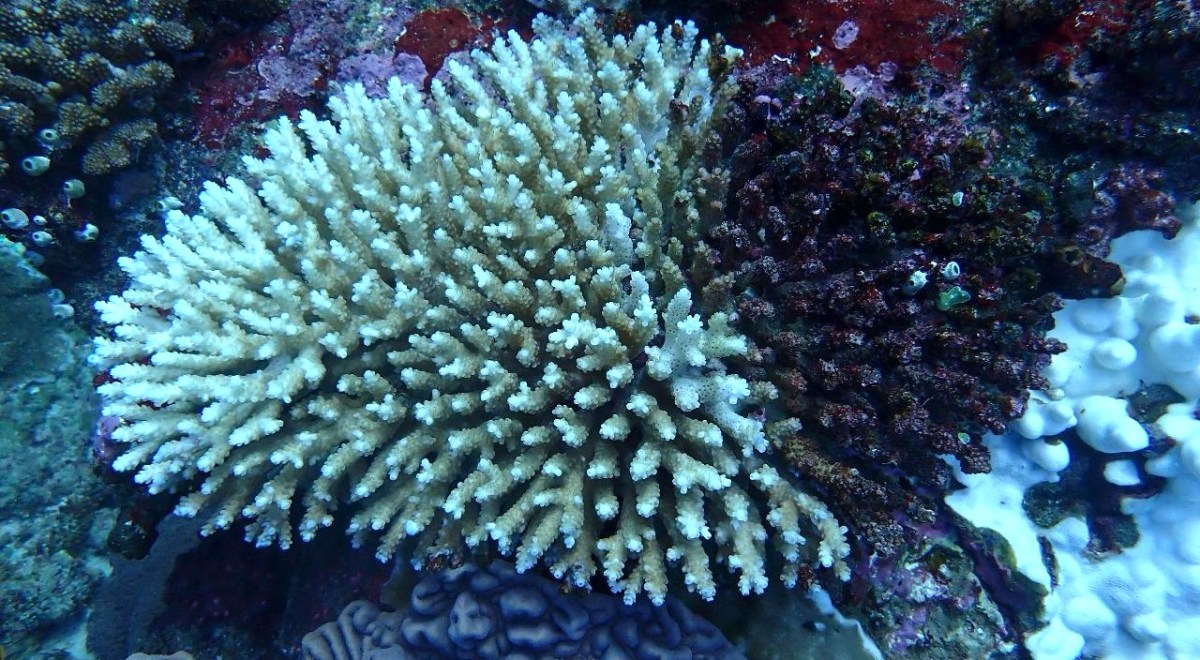
84% of global corals are bleaching – the most extensive coral bleaching event on record – from the combined effects of increased ocean warming and increasing acidity due to our continued obsession with generating 50 billion tons of CO2– equivalents emissions globally annually (Bond, 2022) from our burning hydrocarbons, insistence on eating meat continuously which increases livestock farming & waste, building with concrete which produces CO2 ( but can later sequester it too), and deforestation.
The photo above was taken this month (April, 2025) in Sodwana, where bleaching has reached 50%. This is earlier than the predicted early-2028 for local coral reefs in iSimangaliso bleaching. One main concern has been recent research showing high levels of run-off organochlorine pesticides[1] accumulating in their soft corals, which could reduce their resilience. Although coral bleaching has drawn significant attention since the 1998 El Niño Southern Oscillation (ENSO) event, which caused 50–60% coral mortality in the Western Indian Ocean (Obura, 2005), coral diseases—often linked to bleaching—have received comparatively little focus (McClanahan et al., 2004). While sea temperatures of 27ºC during April are not unusual at iSimangaliso, the duration of warming and exacerbation of acidification threat is that bleaching becomes die-off, unless the oceans cool. With bleaching, at least when conditions become favourable again the zooxanthellae can settle back into the bleached coral to resume a form of normality. If warming and bleaching continue over an extended period they become vulnerable and susceptible to algae growth and disease.
In context, the news that Impact Oil & Gas and partner TotalEnergies’ have come up dry at their deep water Marula well offshore of Namibia is a relief. Using the Deepsea Mira minisub, they drilled to 6,460m Measured Depth on Block 2913B in the Orange Basin but found no hydrocarbons in the primary target. Following completion of drilling operations, the rig will be demobilized. Whilst this puts pause to “drill, baby, drill”, let’s hope these CEO’s put down their frontiersmen risk-tolerant bluster and recognise the long-term impacts of ongoing oil and gas extraction as folly and existential risk for all.
Meanwhile, please find the Final Scoping Report below for survey activities in block 11B/ 12B to ascertain the potential production sites and pipeline routes from the deep-water field areas in Block 11B/12B onto the shelf and into the adjacent Block 9 (Block 9 is held by PetroSA). This follows the discovery of gas-condensate at the Brulpadda and Luiperd wells within Block 11B/12B. The proposed surveys include bathymetry, sonar, seafloor sampling, and ROV surveys in a maximum survey area of interest measuring 8620 km2 within portions of Blocks 11B/12B and 9. The findings of this survey will provide necessary data to inform the design and layout of the intended subsea production facilities and associated infrastructure. Block 11B/12B is located off the South Coast of South Africa, roughly between Mossel Bay and Cape St. Francis. With the recent (2024) withdrawal of TotalEnergies EP South Africa (TEEPSA) partners, Main Street remains as the sole applicant.
Although this is just focused on the survey, we highlight the need to address the concerns around subsea processing for its future application:
Subsea processing technologies, such as seabed separation and pumping, enable greater pressure drawdown, leading to higher production rates and improved oil and gas recovery. By processing fluids on the seabed, the need for large topside facilities is reduced, allowing for more efficient resource extraction. Subsea oil and gas production carries a variety of risks, including environmental pollution, potential harm to marine life, and safety hazards for workers. Its high-tech solutions also hold serious long-term challenges, since it is an unmanned/ remote digitised system requiring an uninterrupted (seabattery) power supply and delivery over a range of wave conditions for its duration. The separated produced water has potential chronic toxicity. Other challenges are marine fouling affecting equipment operability, and unwanted gas in subsea controls umbilicals. Maintenance, waxy crude deposition in pipelines and any replacement in the integrated surveillance systems of subsesa production is expensive and challenging in deepwater.
For more information on 11B/12B please see:
The SLR website: https://www.slrconsulting.com/public-documents/11b12bsurveys/
Data free website: https://slrpublicdocs.datafree.co/public-documents/11b12bsurveys/
Photo cred: Dr J. Olbers
[1] Tyohemba, R. L., Humphries, M. S., Schleyer, M. H., & Porter, S. N. (2022). Accumulation of commonly used agricultural herbicides in coral reef organisms from iSimangaliso Wetland Park, South Africa. Environmental Pollution, 294, 118665.
Bond, P. (2022) The Case for Ecosocialism in the Face of the Worsening Climate Crisis. Science & Society 86(4) 485-515

 Oceans Not Oil